
St Mary-le-Bow’s Heritage
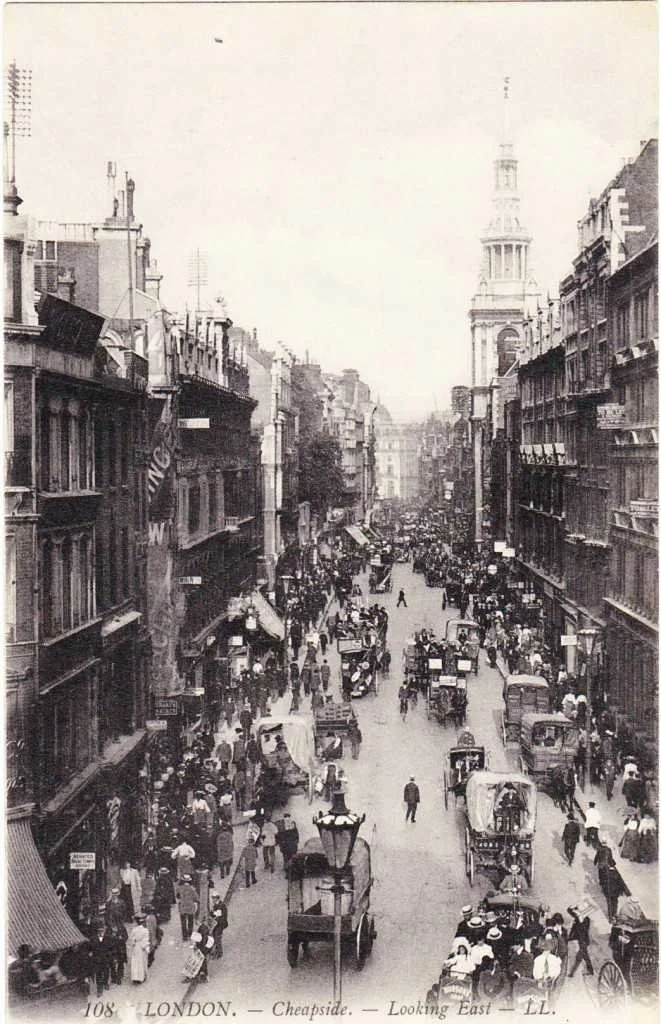
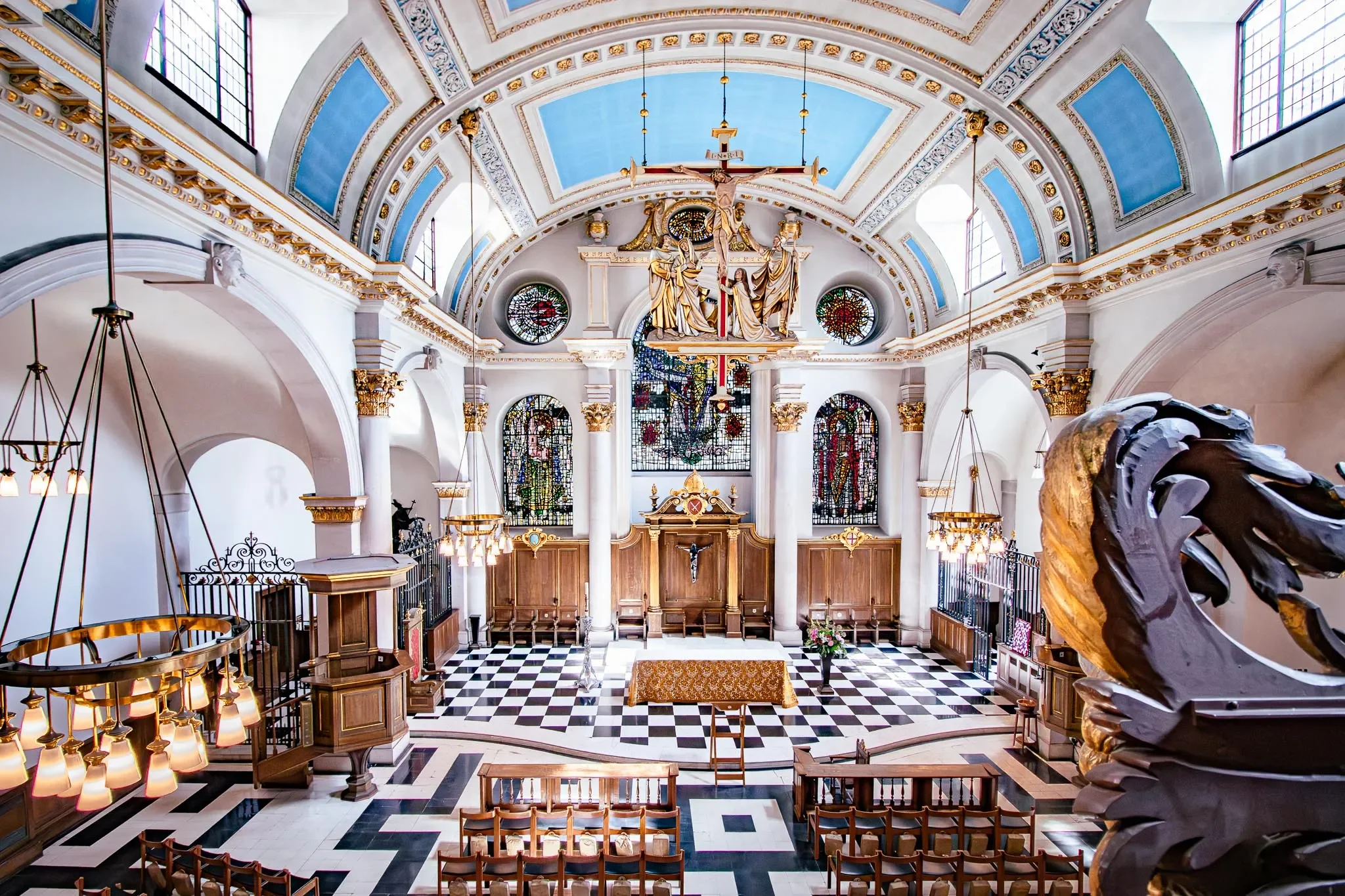
St Mary-le-Bow has stood on Cheapside for nearly a thousand years. Its fabric bears the marks of that long history, from the medieval crypt and Wren’s rebuilding after the Great Fire to the stained glass, furnishings and restoration that followed the destruction of the Second World War.
Explore the building and some of the stories, people and traditions associated with it below.
A Church Shaped By Centuries Of London Life
Quick Links
There is much to discover at St Mary-le-Bow. Choose a subject below to explore its history and place within the church.
Architecture, Wren and the medieval crypt
John Hayward's post-war windows
Their history, traditions and sound
The instrument and it’s musical heritage
St Mary-le-Bow's place in London's civic history
Relationships extending beyond London
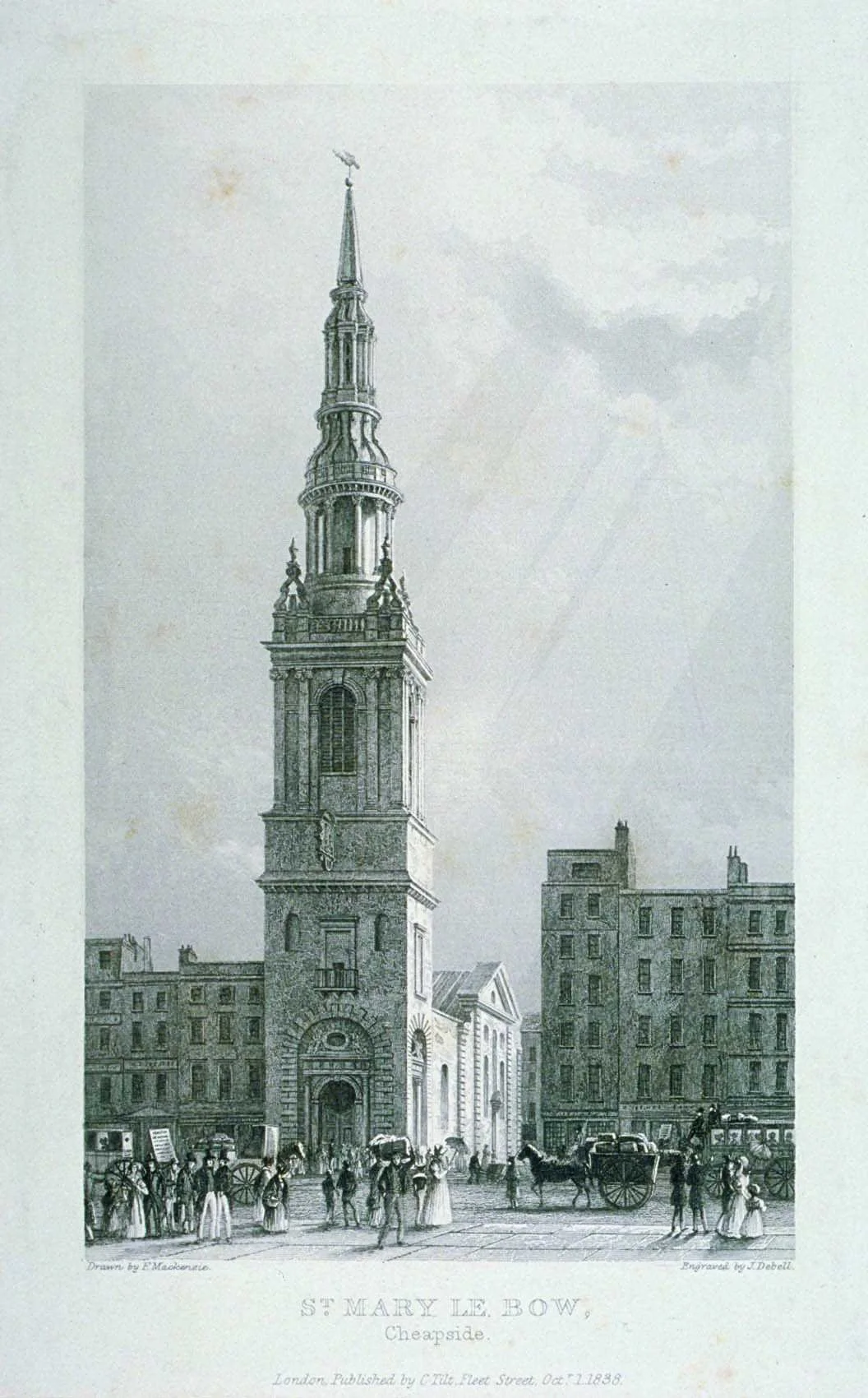
The Building
The story of St Mary-le-Bow begins in around 1080, when Lanfranc, Archbishop of Canterbury, established a church here as his London headquarters.
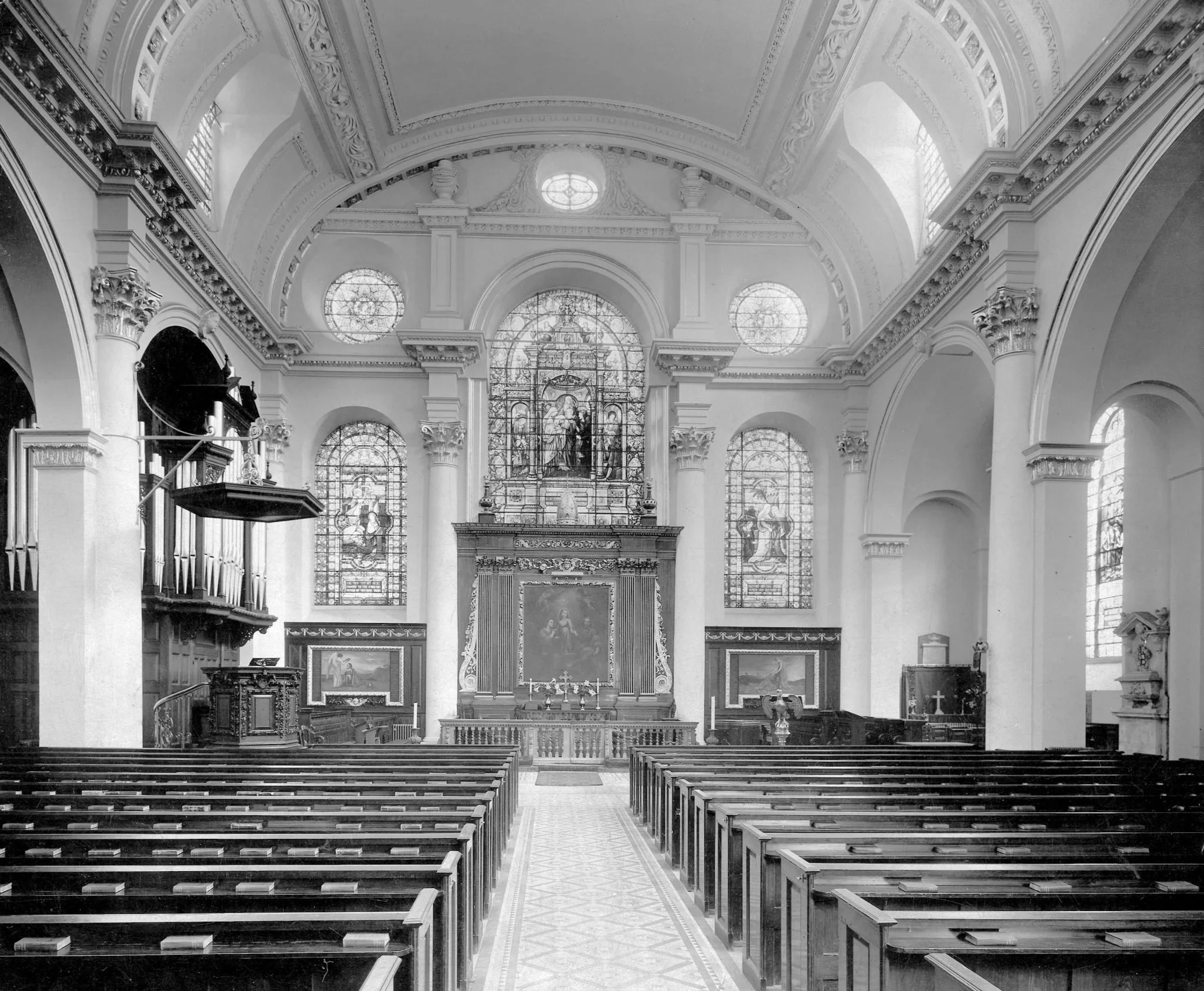
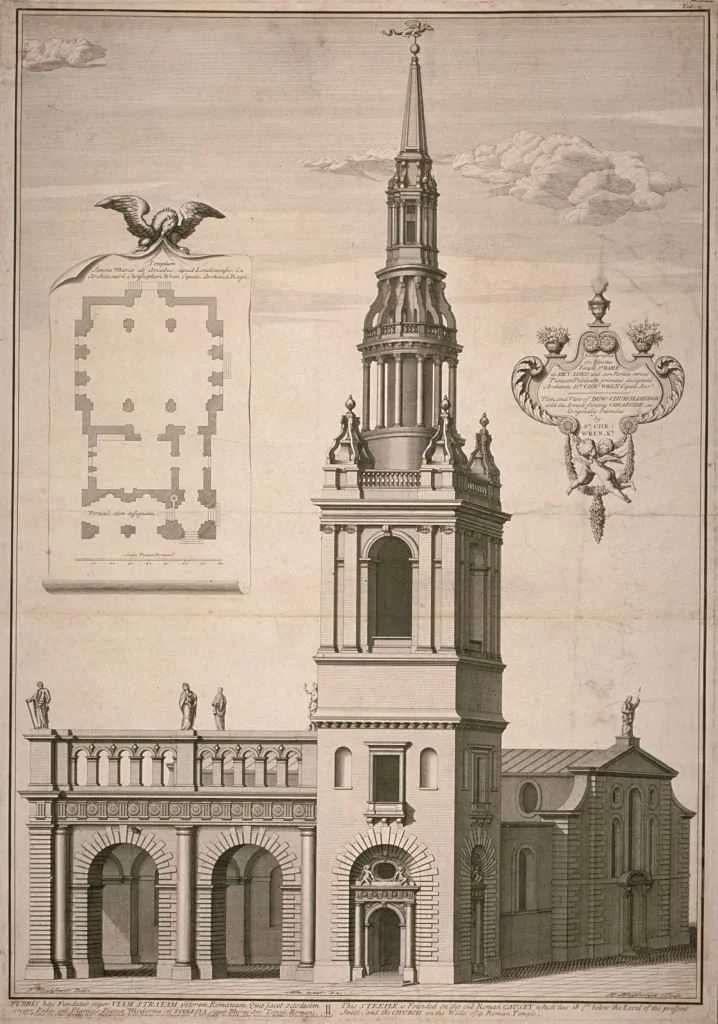
The building standing above ground today is principally the work of Sir Christopher Wren. After the Great Fire of London destroyed the medieval church in 1666, St Mary-le-Bow was among the City churches Wren rebuilt. Its tower and steeple became one of the landmarks of the rebuilt City.
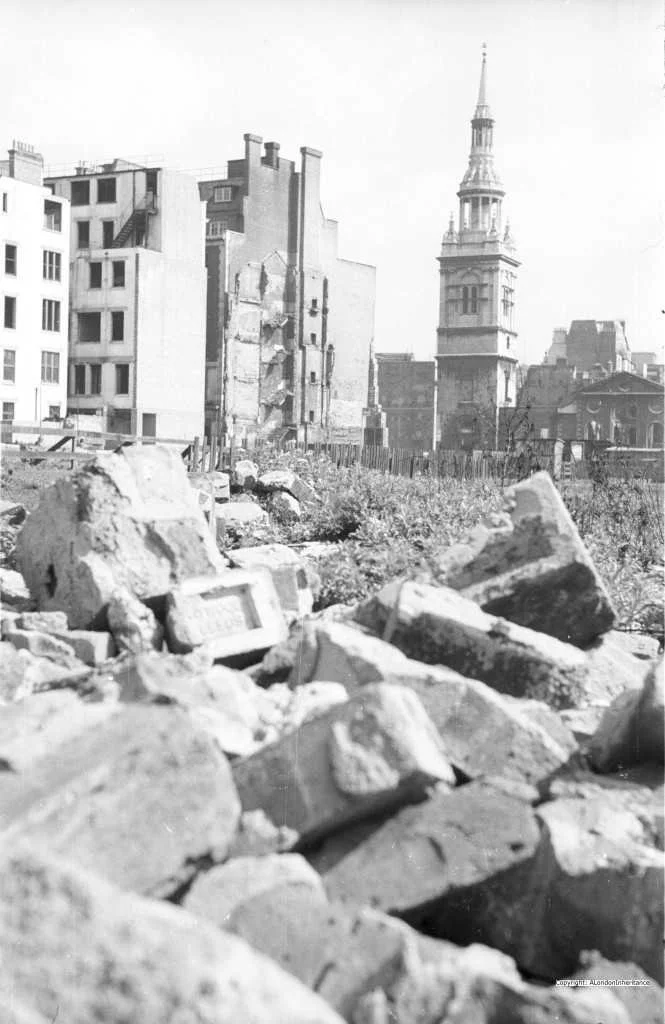
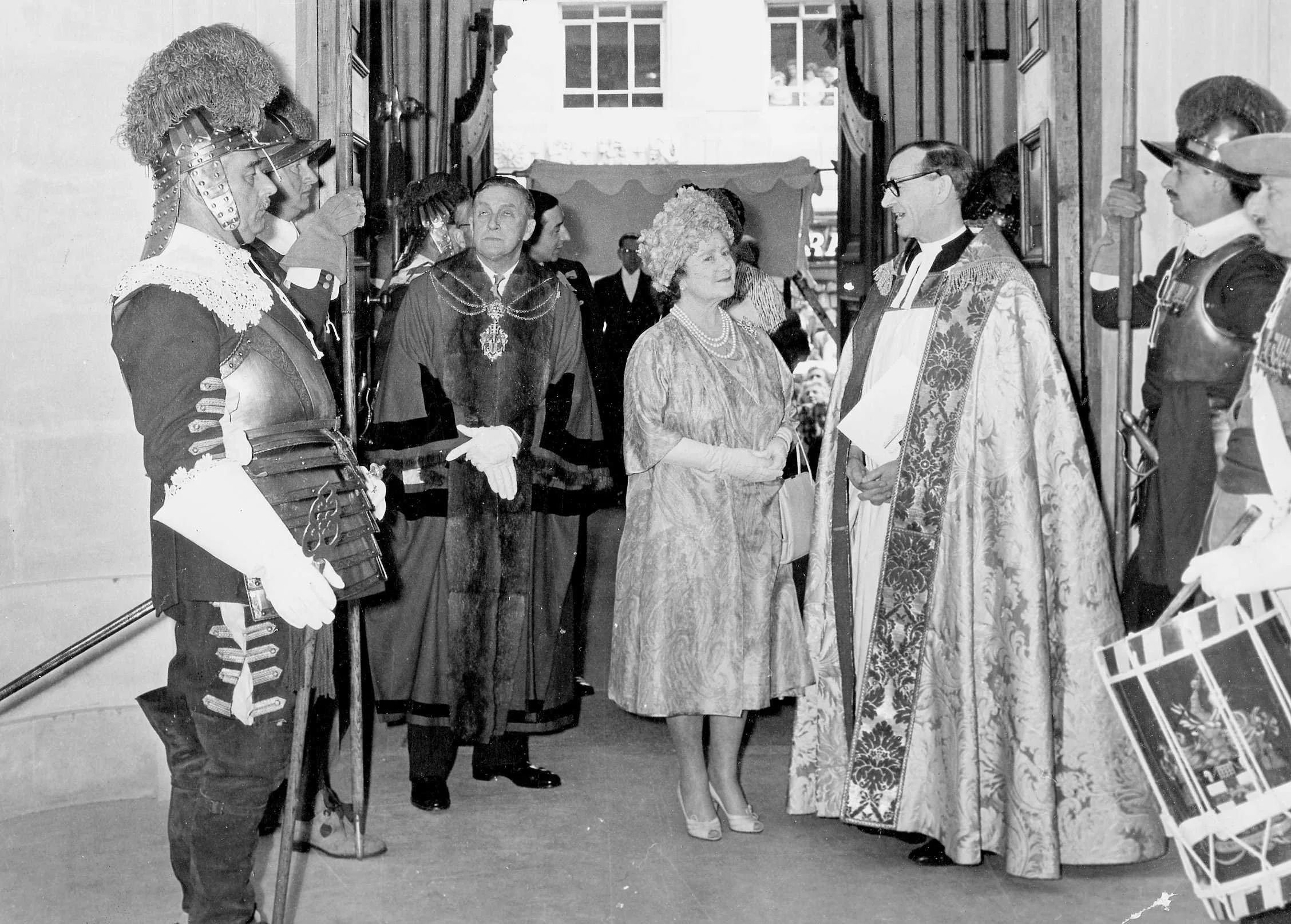
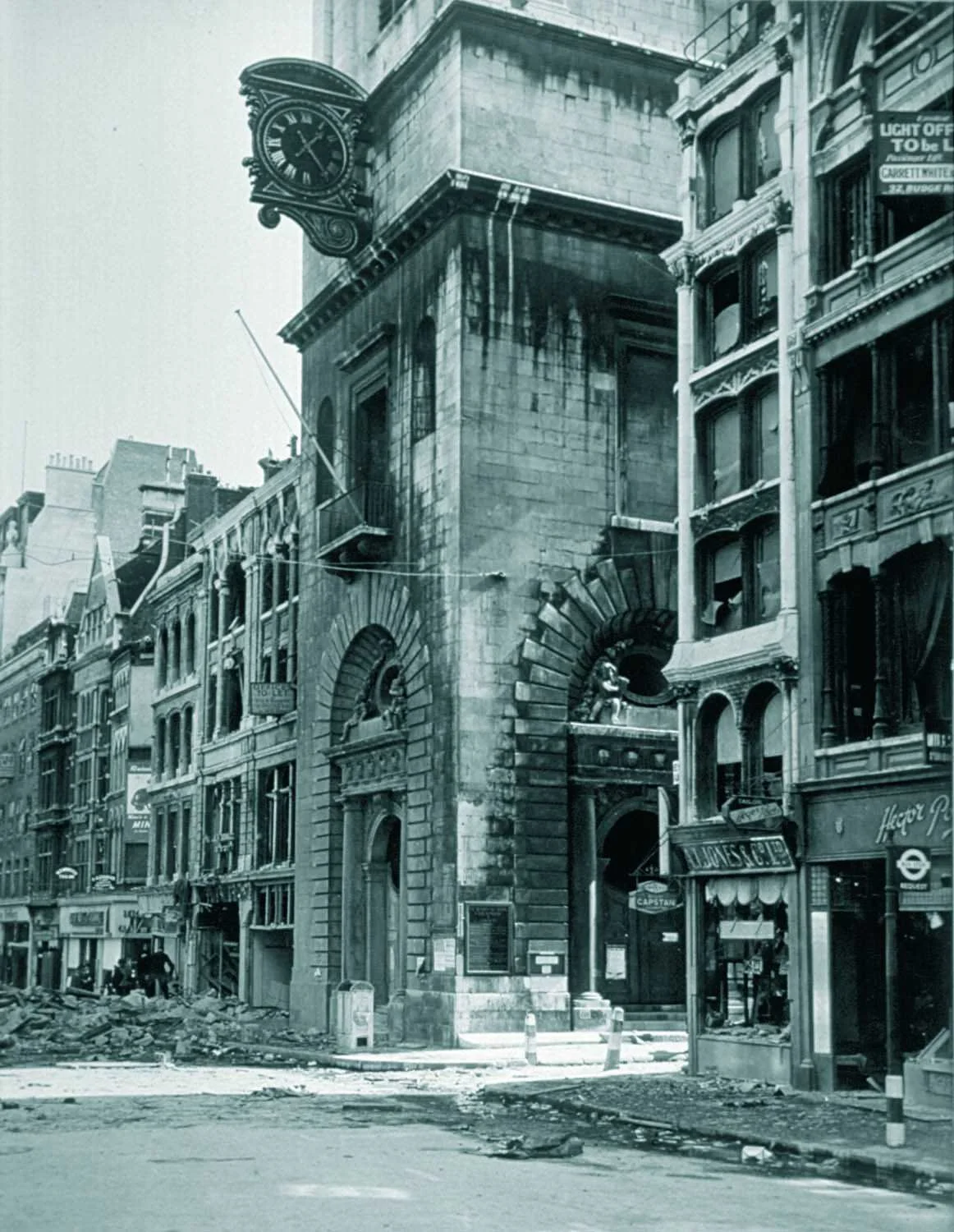
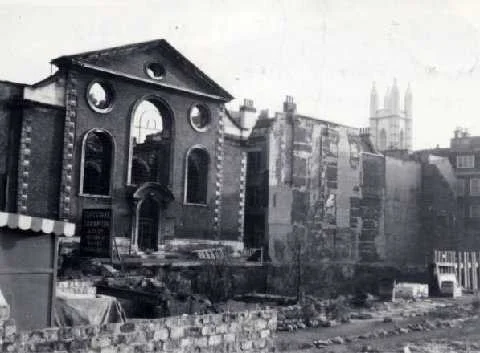
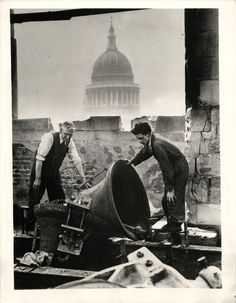
War brought destruction once again. On 10 May 1941, an air raid left much of the church in ruins. Restoration took more than two decades, culminating in the church’s reconsecration in 1964.
What survives today is therefore not the work of one period. Medieval foundations, Wren’s architecture and twentieth-century restoration sit together within the same building.
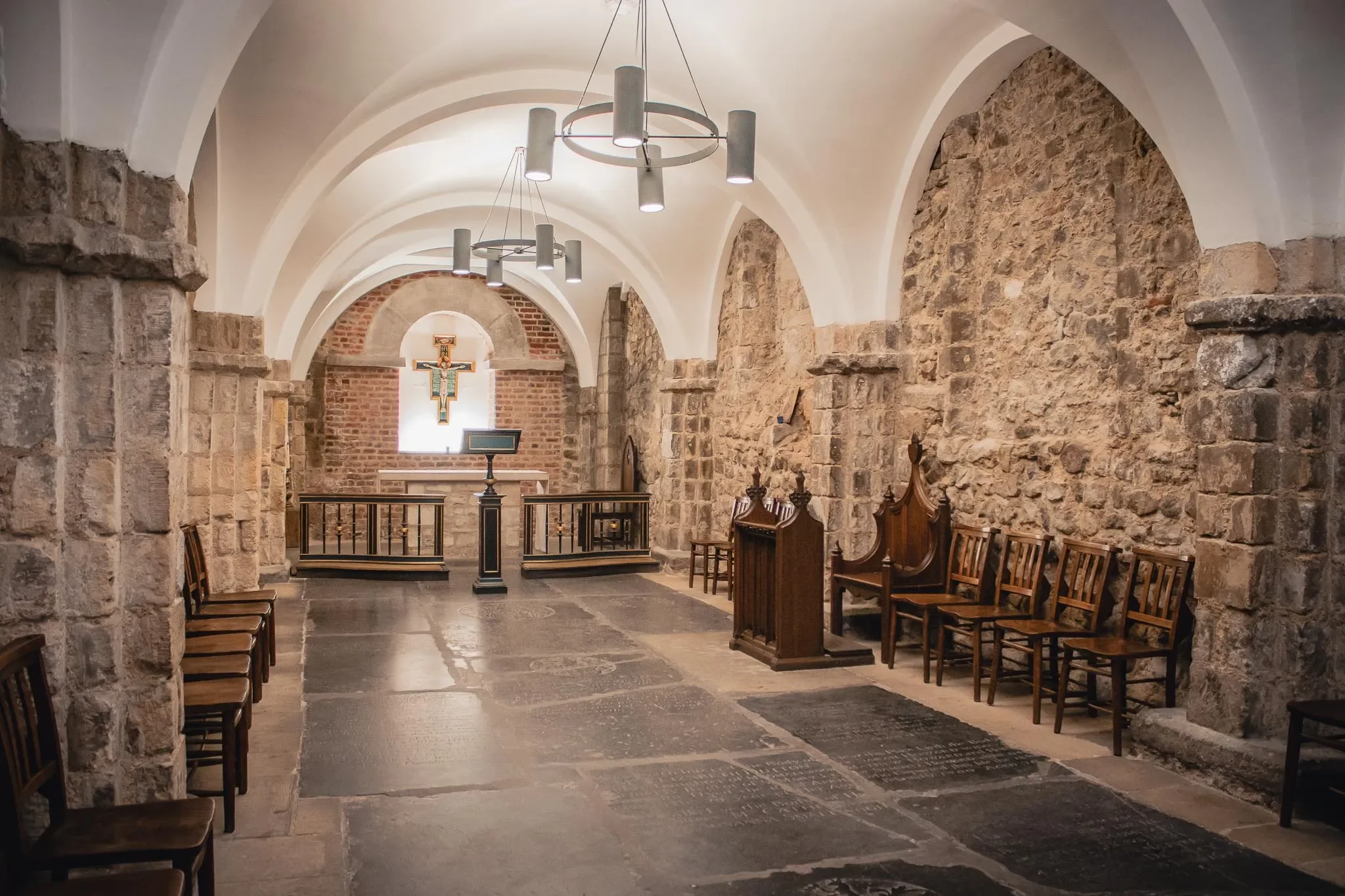
The Norman Crypt Chapel
The oldest surviving part of St Mary-le-Bow lies beneath the church. Dating from around 1080, the Norman crypt was originally an undercroft, built to support the church above. Its wide nave and narrow aisles were constructed using Caen stone imported from Normandy, the same stone used at the Tower of London. Remarkably, around 60% of its original late-11th-century fabric survives.
The crypt's distinctive Norman arches may even explain the church's name: le-Bow is thought to derive from de arcubus, meaning ‘of the arches’. Following the Great Fire of 1666, Christopher Wren apparently mistook the crypt for a Roman structure and encouraged its use as a burial chamber. For a time, it could only be reached through a trapdoor and by ladder, until George Gwilt later added a staircase. A fragment of a medieval staircase also survives in the north-west corner, possibly once connecting the crypt with the medieval tower.
Today, this remarkable survival of the medieval church is once again a place of Christian worship. Known as the Crypt Chapel of the Holy Spirit, it continues to be used for prayer and the Eucharist, connecting the earliest surviving fabric of St Mary-le-Bow with the worshipping life of the church today.
St Mary-le-Bow Through The Years
c.1080
First church
1666
Great Fire
1670s
Wren rebuilding
1941
Bombing
1964
Reconsecration
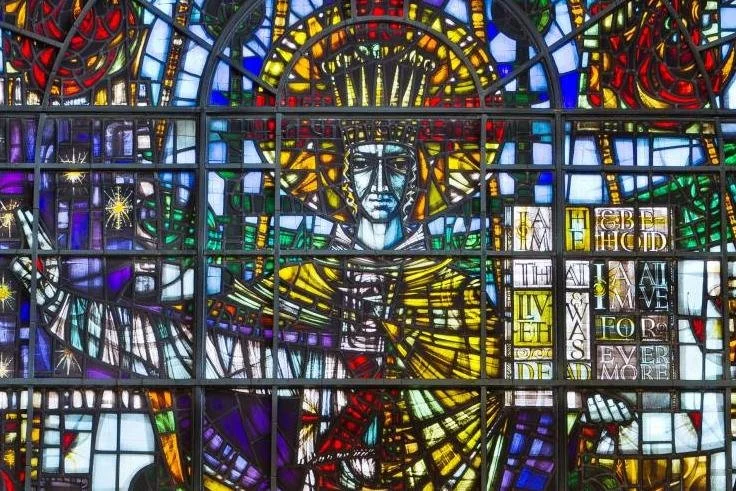
The Stained Glass
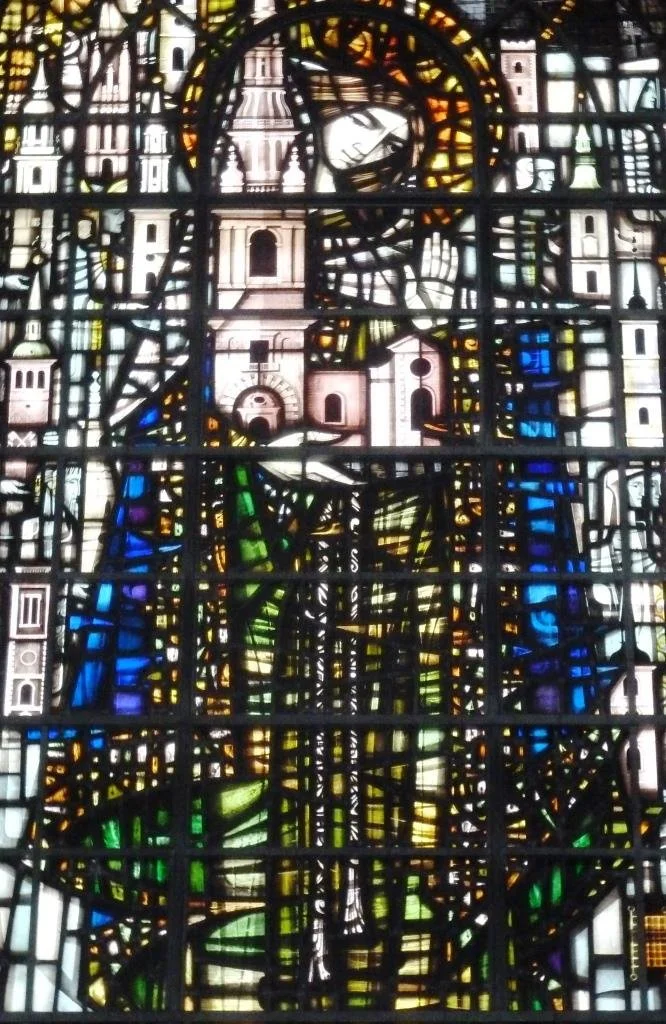
The stained glass at St Mary-le-Bow belongs to the church’s post-war restoration.
Designed by John Hayward, the windows bring Christian imagery into conversation
with the City in which the church stands.
The City itself appears in the glass. Among the imagery are the City seals, Mansion House
and Guildhall, alongside the arms of the Great Twelve Livery Companies.
The windows therefore tell two intertwined stories: the church's Christian faith
and its longstanding relationship with the civic life around it.
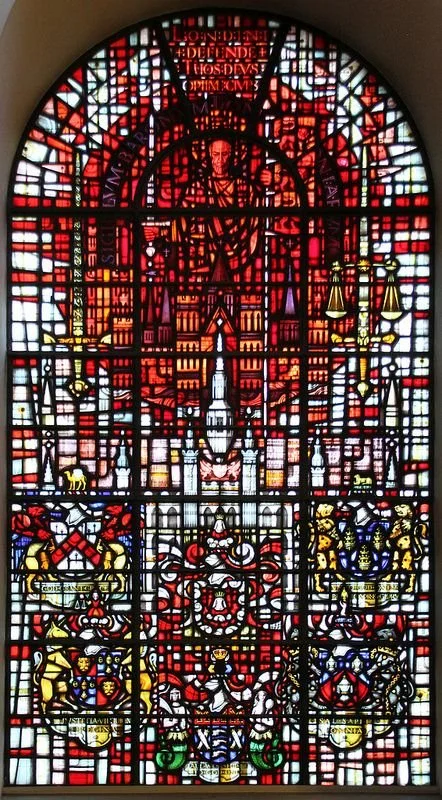
St Paul & City Emblems
This window shows the Common Seal in which the figure of St Paul is shown within the City walls, with the sword of his martyrdom in his right hand and the standard of England in his left. Below the seal is the Guildhall, the seat of government in the City of London and the further six coats of arms of the Great Twelve Livery Companies of the City. The lunette above shows the arms of the City of London.
Christ in Majesty
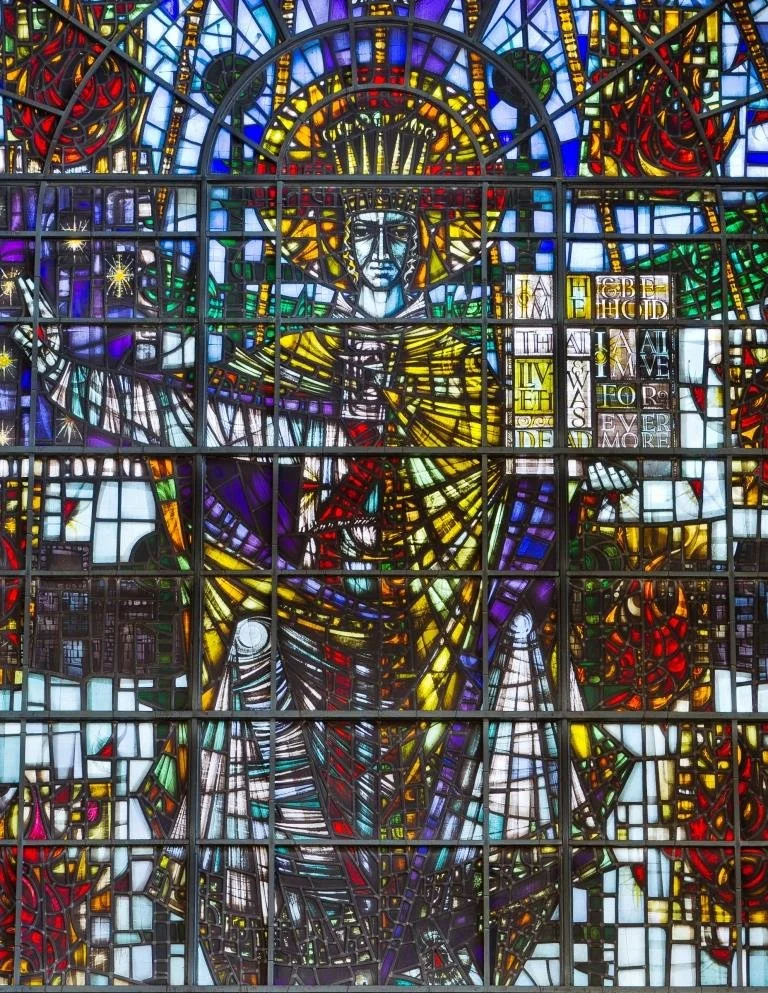
The seven stars are seen to emanate from the right hand of Christ (Revelation 1:20 – ‘the seven stars are the angels of the seven churches’). Hayward adds to this the seven flames around the person of Christ, representing the seven gifts of the Holy Spirit; wisdom, understanding, counsel, inward strength, knowledge, true godliness and delight in the fear of the Lord. The main figure is of Jesus the Christ, vested as a priest and seated – he is God the Son, and above him hovers the heavenly dove, the symbol of God the Holy Spirit.
The Blessed Virgin Mary
To the north (left) of the sanctuary is depicted the Patron of the parish, the Blessed Virgin Mary, holding (and thus symbolising her care for us) the church built by Wren. She is clothed in blue (the traditional colour for Our Lady) and her feet appear to be resting on the arches of the crypt. Surrounding Our Lady’s image are seventeen Wren churches which survived the Second World War, each held by the patron saint of the parish.
St Paul
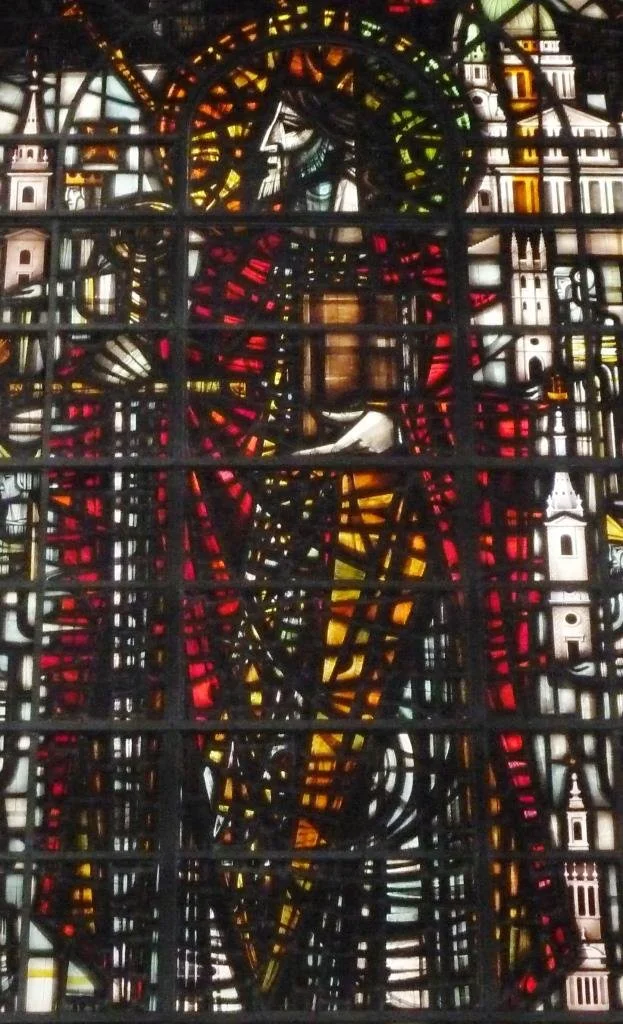
The south (right) window depicts the Patron of the diocese of London, St Paul the Apostle holding the sword with which he was martyred (he was beheaded in Rome in 67AD) and the book of his Letters which are to be found in the New Testament. He is turn is surrounded by 11 churches, together with the Cathedral, which survived the Second World War.
Thomas Becket & St Paul
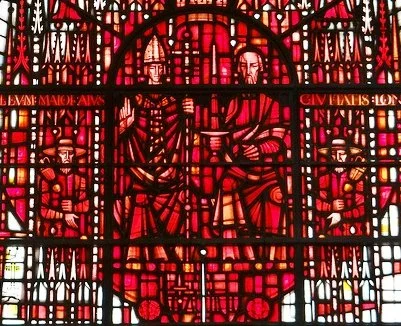
The left window is dominated by the Great Seal of the Lord Mayor of the City, in red with its figures of St Paul and Thomas à Beckett (born in a house on the other side of Cheapside and martyred at Canterbury in 1170). Below the seal is the Mansion House, the residence of the Lord Mayor. The lower half of the window shows the coats of arms of six of the Great Twelve of the Livery Companies of the City. The circular lunette above shows the Lord Mayor’s regalia.
The Bow Bells
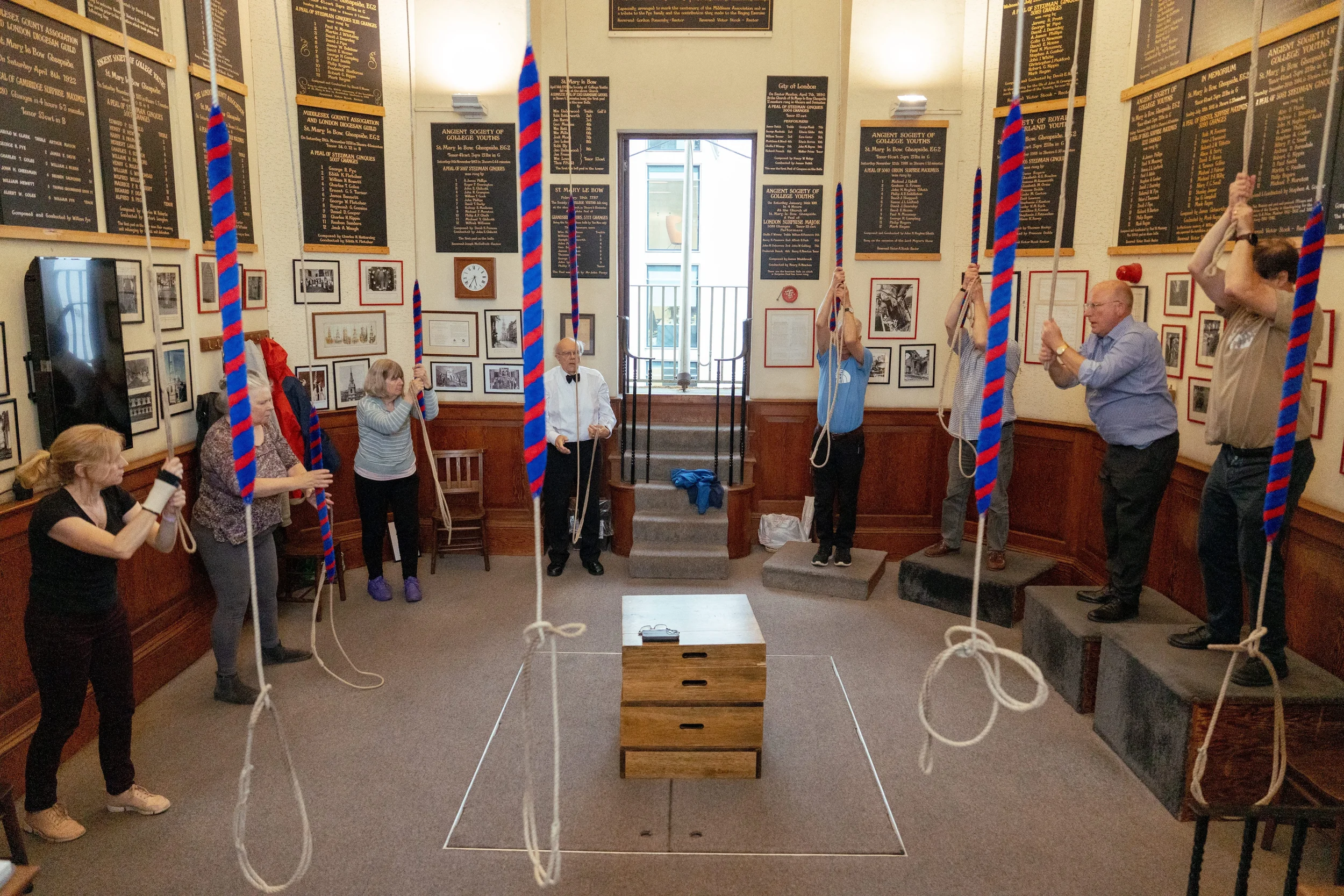
Few parts of St Mary-le-Bow have travelled quite so far into popular culture as its bells.
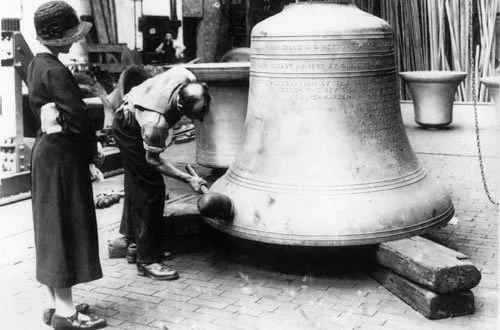
Bow Bells have sounded over Cheapside for centuries. They became associated with the legend of Dick Whittington and, most famously, with the traditional definition of a Cockney as someone born within the sound of Bow Bells.
The bells continue to ring from the tower today.
The Organ
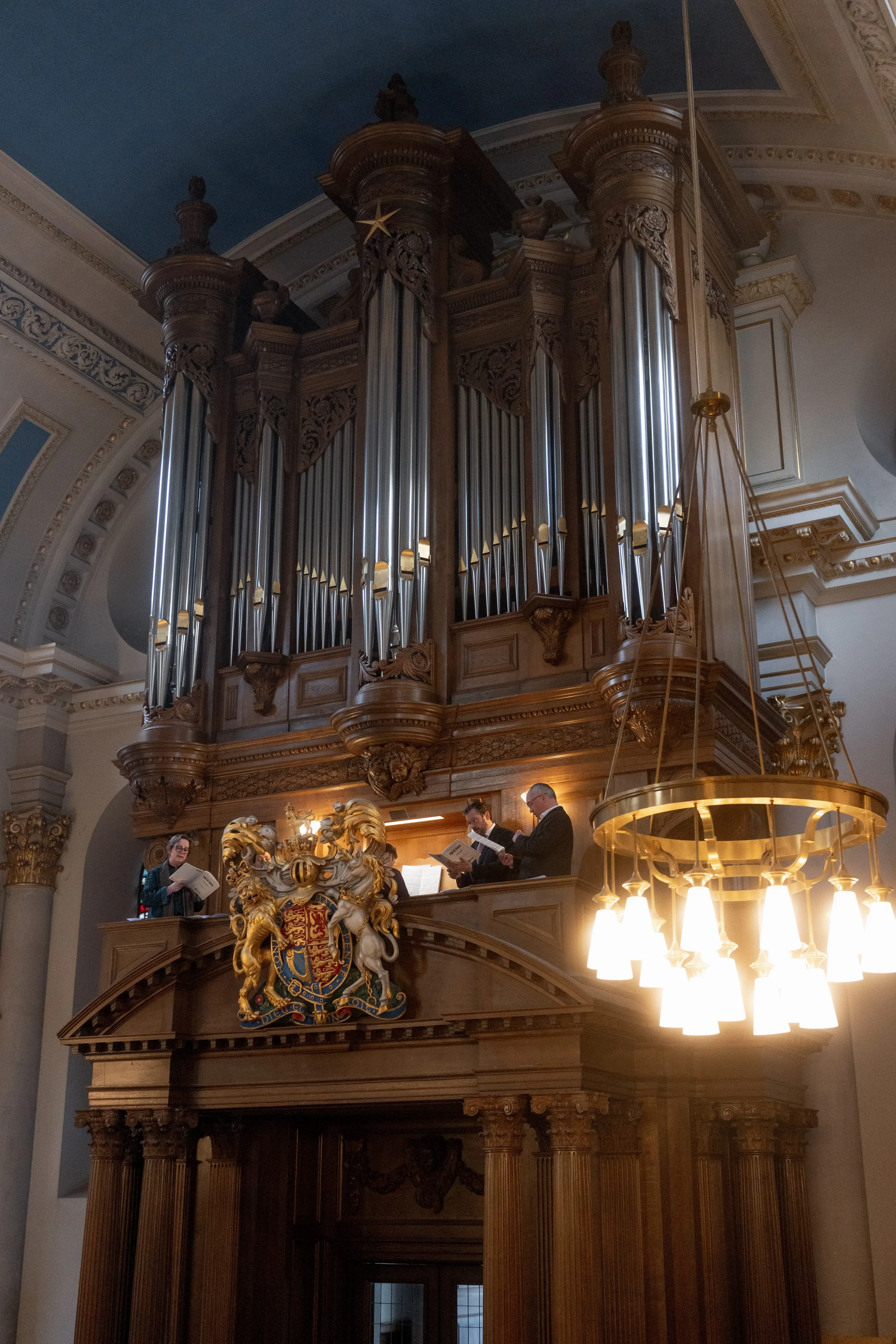
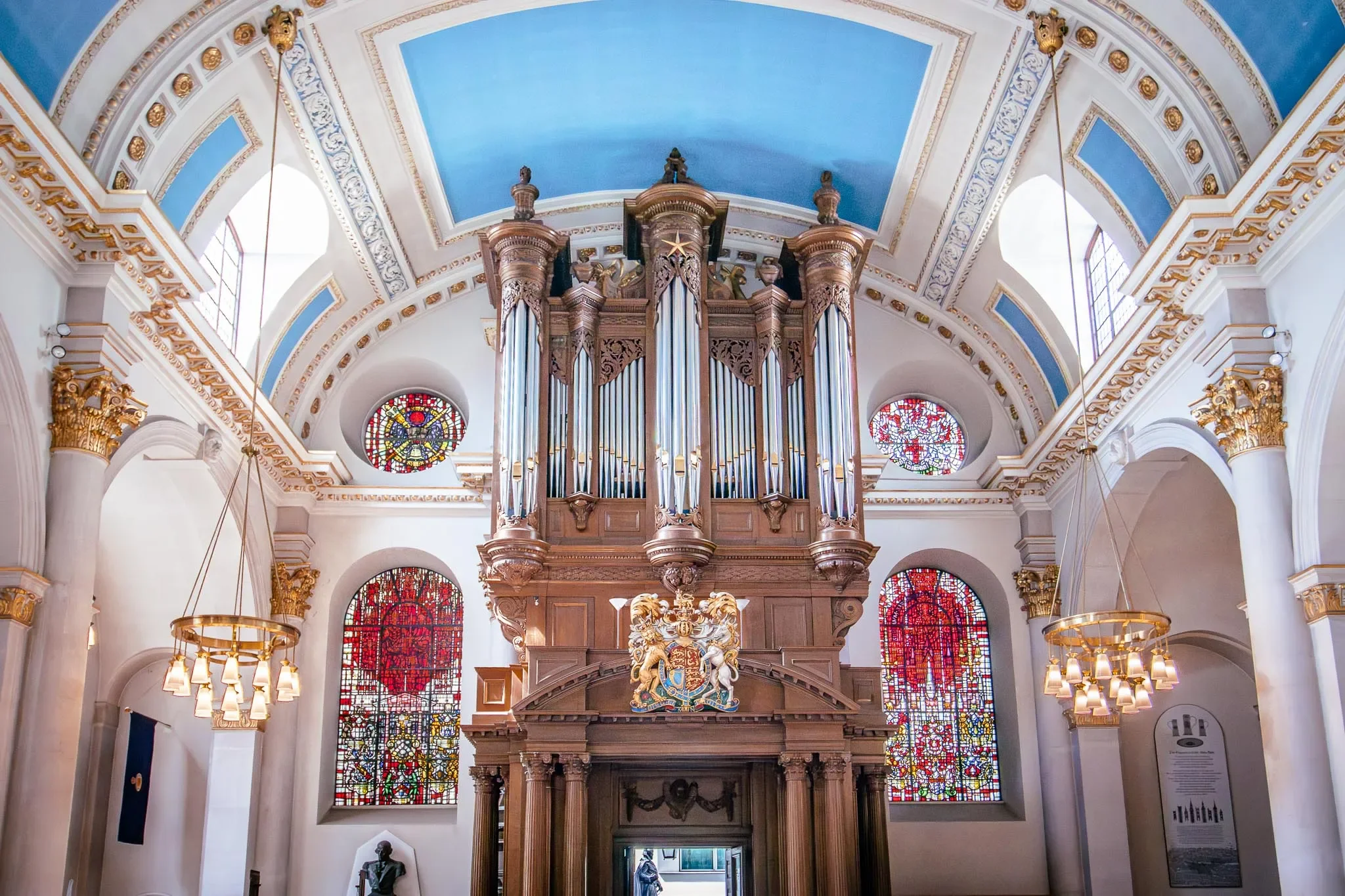
The organ may sound entirely at home within St Mary-le-Bow, but it is one of the more recent additions to the building. Kenneth Tickell & Company built the present instrument and installed it in 2010. Its design draws on earlier European organ-building traditions while serving the worship and musical life of St Mary-le-Bow today.
It is another layer in a building that has continually adapted while retaining its inheritance.
-
Great
Bourdon 16
Open Diapason 8
Stopped Diapason 8
Gamba 8
Principal 4
Spitz Flute 4
Fifteenth 2
Cornet III
Furniture IV
Trumpet 8
Cromorne 8
Tremulant
Swell to GreatSwell
Chimney Flute 8
Viola 8
Voix Celeste 8
Principal 4
Traverse Flute 4
Nazard 2 2/3
Open Flute 2
Tierce 1 3/5
Larigot 1 1/3
Mixture III-IV
Bassoon 16
Trumpet 8
Hautboy 8
Tremulant
Bow Bells (Cymbelstern)Pedal
Sub Bass 16
Violone 16
Principal 8
Open Flute 8
Octave 4
Trombone 16
Trumpet (from Gt) 8
Swell to Pedal
Great to PedalTracker key action
Slider soundboards
Electric stop and combination actions
St Mary-le-Bow
& The City
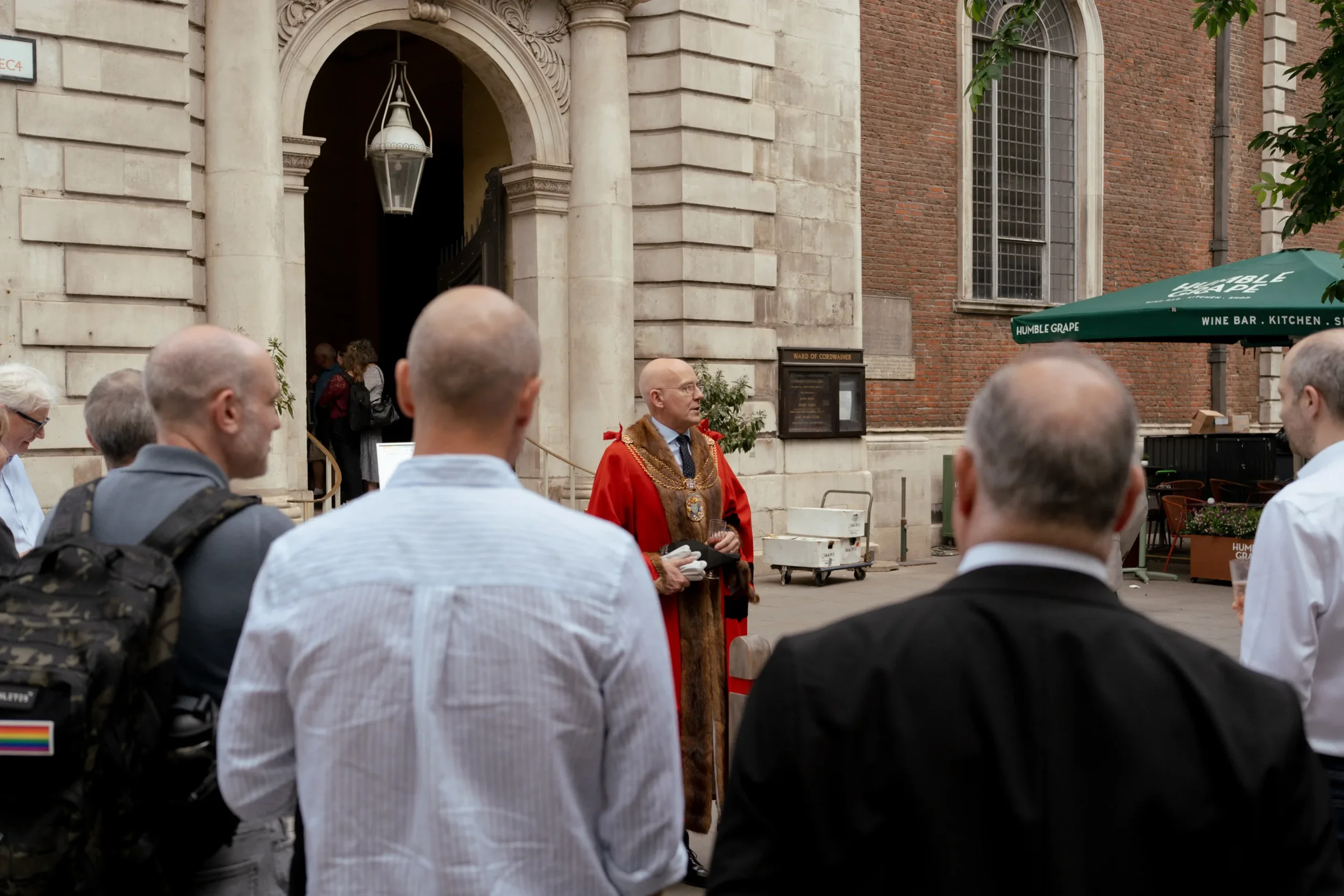
The history of St Mary-le-Bow has never been confined to its walls.
Its position on Cheapside placed it on one of medieval and early modern London’s great thoroughfares. Royal and civic processions passed nearby, while the street outside became a setting for public spectacle and celebration.
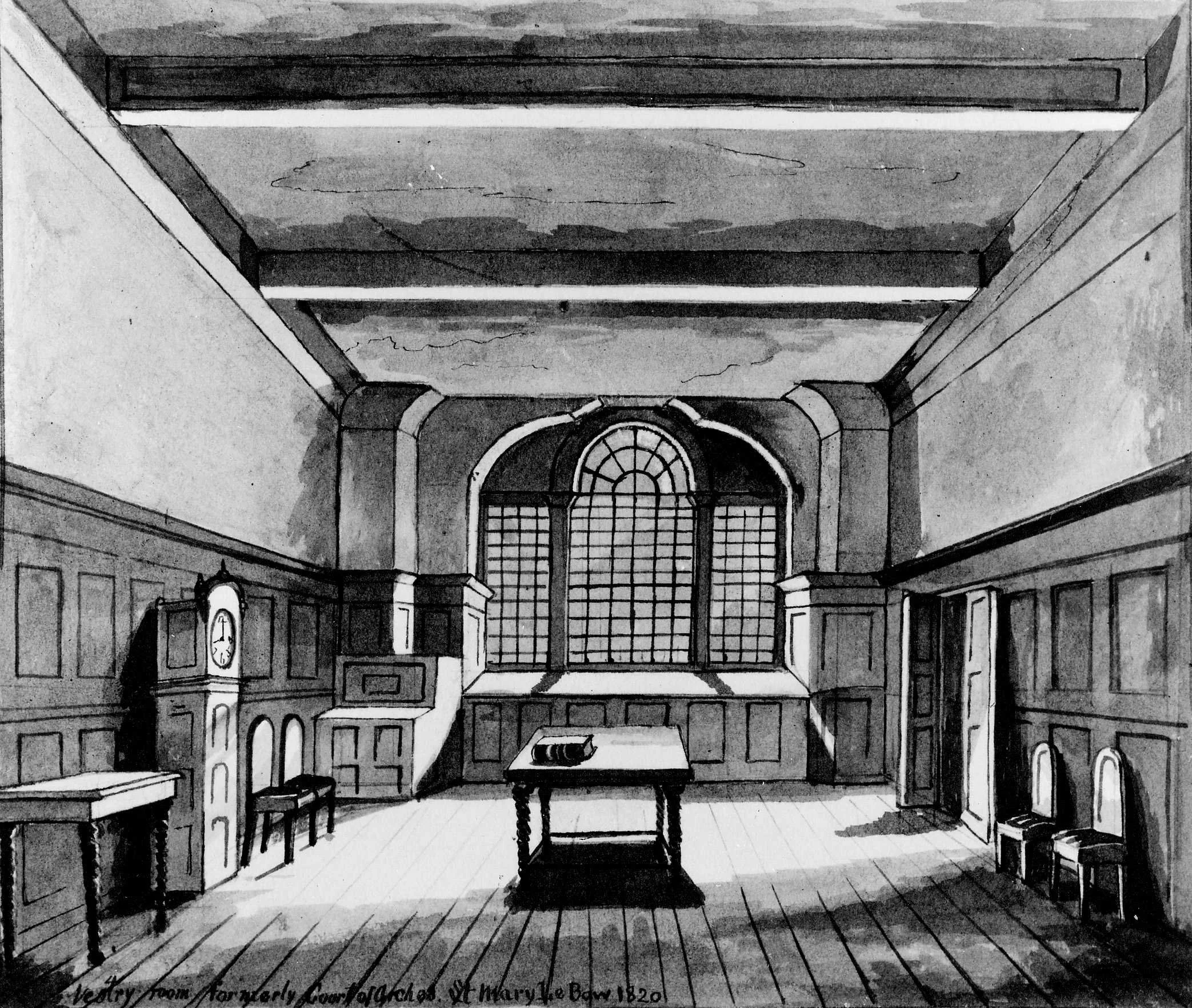
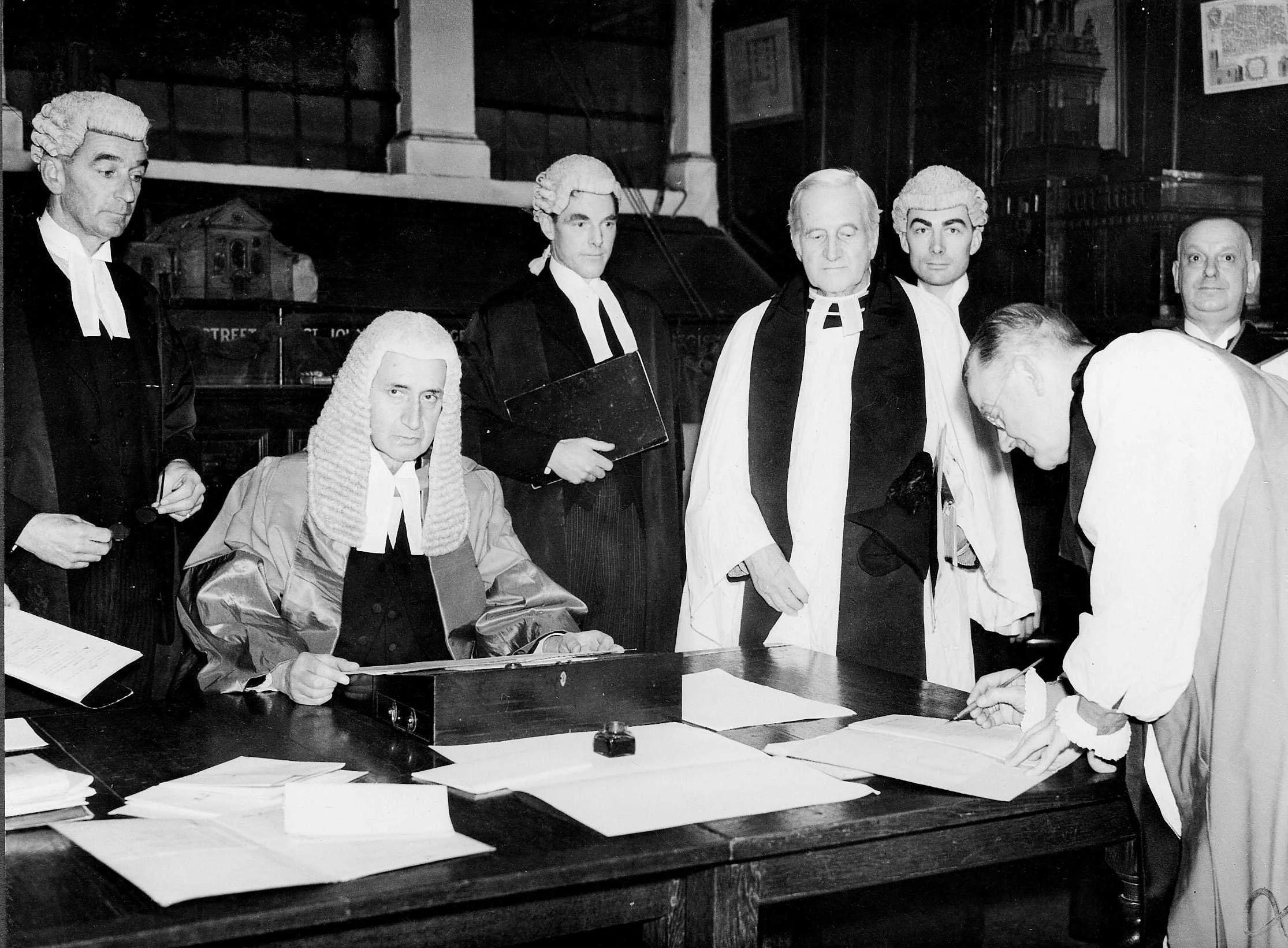
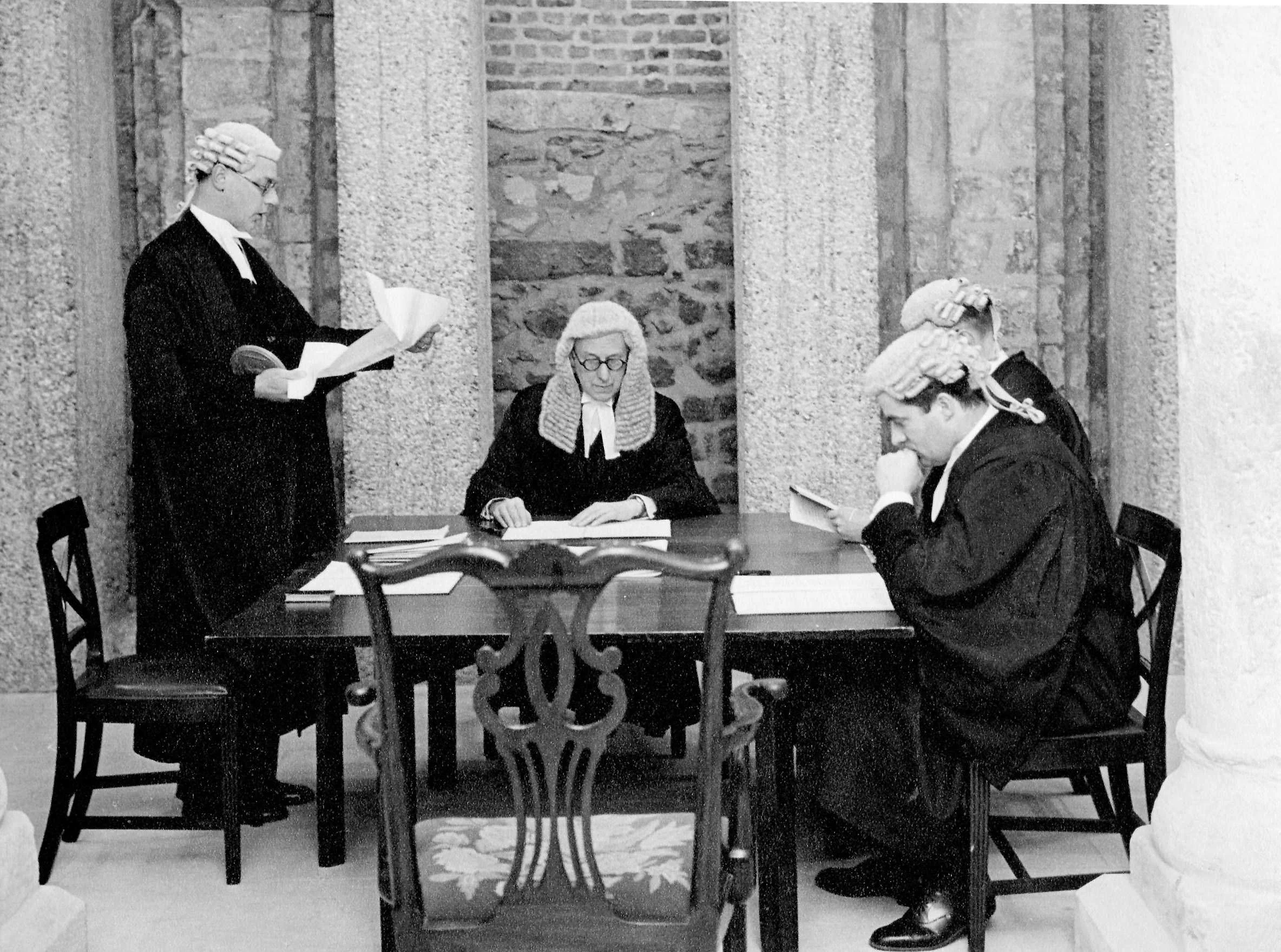
The church also gave its name to the Court of Arches, the senior ecclesiastical court of the Province of Canterbury. Its story connects St Mary-le-Bow with centuries of English church law.
Its relationship with the institutions of the City can still be seen within the building, including the civic imagery incorporated into its post-war stained glass.
Connections Beyond London
A Friendship Across The Atlantic
One of St Mary-le-Bow’s most significant international relationships is with Trinity Church Wall Street in New York. The connection reaches back to the seventeenth century. When Trinity's parish was established in 1697, its Vestry was instructed to operate according to the use of St Mary-le-Bow.
More than two centuries later, the relationship took on new significance. Following the destruction of St Mary-le-Bow during the Second World War, support from Trinity contributed to the church’s restoration.
The relationship continues today.
Australia and Admiral Arthur Phillip
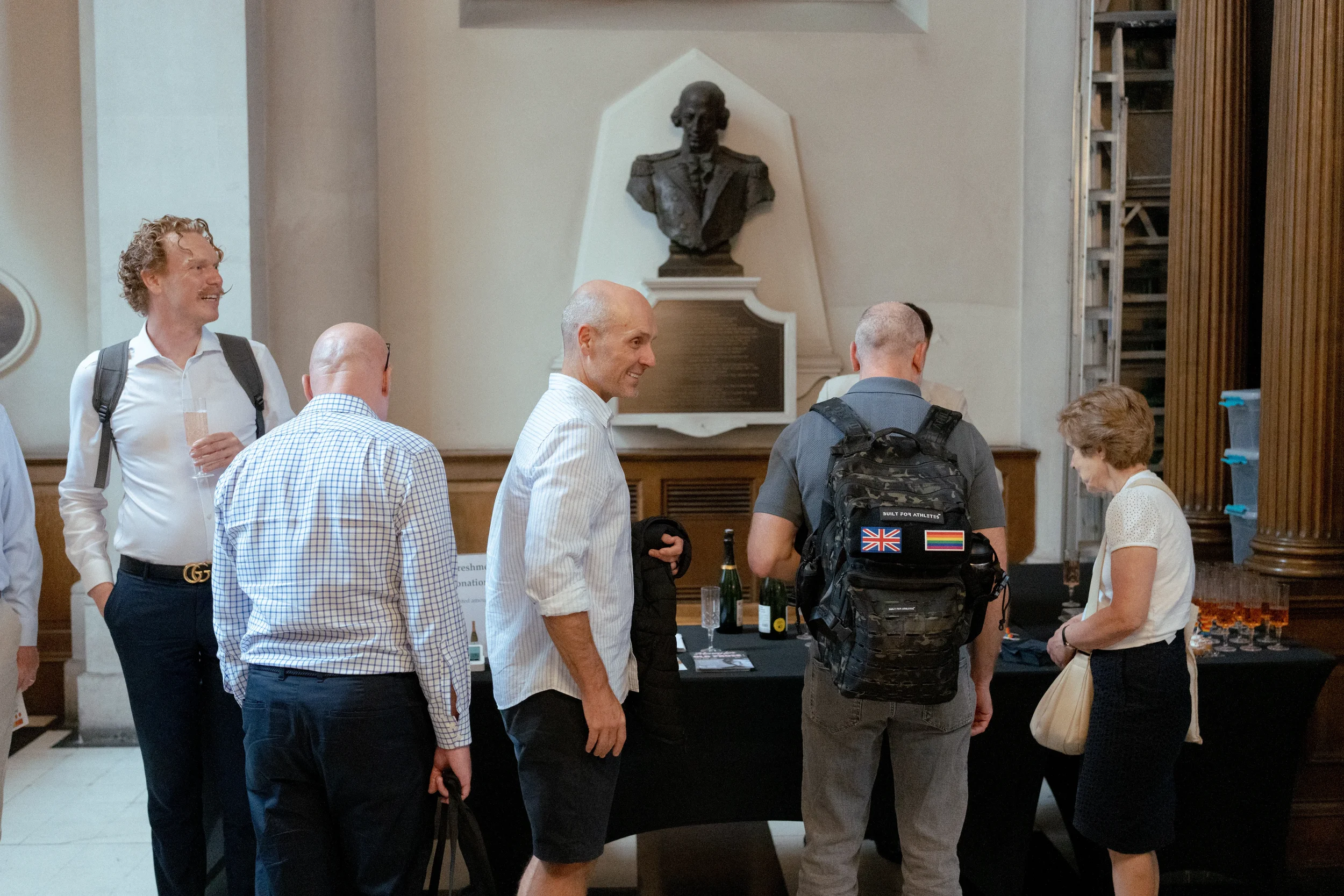
St Mary-le-Bow has a longstanding place in the life of the Australian community in London. At the heart of that connection is Admiral Arthur Phillip, commander of the First Fleet and first Governor of New South Wales, who was born nearby in Bread Street in 1738 and baptised in one of the historic parishes now united with St Mary-le-Bow.
Today, his bronze memorial stands in the church, while an annual service continues to commemorate his life and legacy. Through its association with the Britain-Australia Society, St Mary-le-Bow remains a gathering place for Australians in London.
St Mary-le-Bow Today
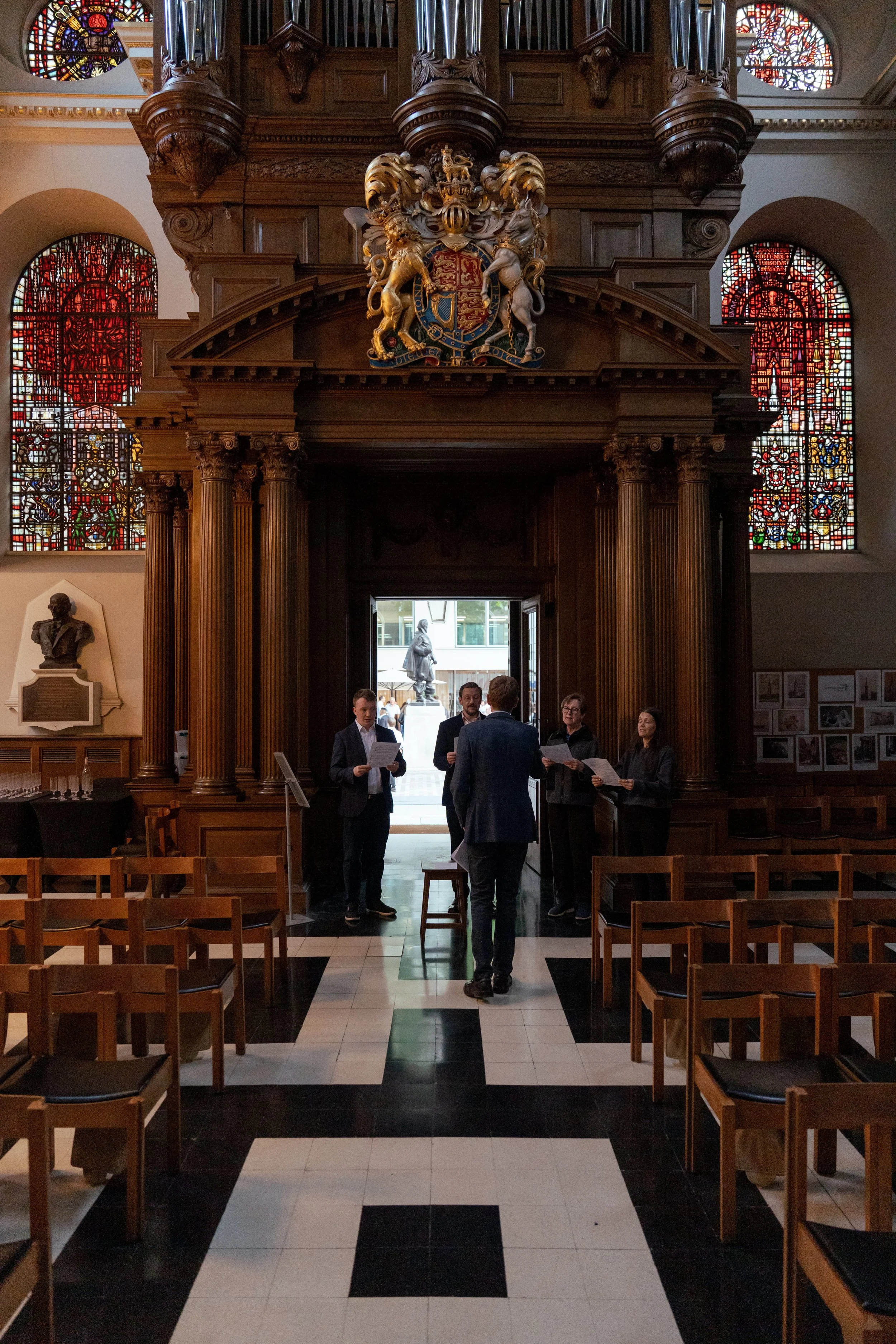
St Mary-le-Bow has a long, fascinating history, but it is also a living church.
Find out more about who we are, what we do and our place in the life of the City today.